LGBT group faces state persecution in Indonesia

25 January 2016

Several public officials issued statements on the weekend opposing the presence of lesbian, gay, bisexual and transgender (LGBT) students on university campuses following the cancelation of an event at the University of Indonesia (UI).

Research, Technology and Higher Education Minister M. Nasir said that LGBT communities could taint the nation’s morality if “the guardians of morality [do not] promote decency and the noble values of Indonesia”, as quoted by Antara news agency.

Lawmaker from the Prosperous Justice Party (PKS), Muhammad Nasir Djamil, also commented. “LGBT groups cannot be allowed to thrive and be given space. Especially considering that they have entered campuses through academic discussion,” lawmaker Nasir said.

Sociologist and gay-rights activist Dede Oetomo told The Jakarta Poston Sunday that he would be generous and forgiving in his response, calling the statements of both Nasirs demonstrative of “limited knowledge in general, in particular on sexuality and human rights”.

“We have to understand that even the international world and the United Nations have recognized the rights of LGBT [communities] only recently,” he said. Therefore, he would not be offended by the statements. “They simply never learn anything new,” he went on.

He said, however, that he had concerns about the welfare of LGBT communities on campuses after the weekend witch-hunt for the minority group.

Conservative Islamic newspaper Republika ran the headline “LGBT poses serious threat”, on its front page. The article quoted sources that slammed LGBT people for “tainting the nation’s morality”, citing links between LGBT communities and promiscuity. Some other media outlets also presented LGBT issues as a threat, using terms such as “deviant sexual behavior”.

The statements were made in response to the Support Group and Resource Center on Sexuality Studies (SGRC) at UI coming under the spotlight due to its “appropriation” of UI’s name and logo.

An unofficial poster for the LGBT Peer Support Network, a counseling service provided by SGRC-UI in cooperation with melela.org, a website that provides a platform for LGBT people to share their stories and experiences as a way of improving the public’s understanding of these minority groups, went viral on social media last week, triggering controversy among social media users.

Many social media users posted comments on #dukungSGRCUIvoicing their support for the community’s activities. Meanwhile, a number of messages circulated encouraging people to initiate anti-LGBT movements on UI’s campus.

The controversy prompted UI authorities to issue a statement saying that the university was not responsible for the organization’s activities because the organization had not registered as a university student society and had not obtained a permit from the university to carry out its activities.

The university has asked SGRC-UI to remove the university’s name and symbol from the its logo.

“It’s important to note that SGRC is not a campus organization and UI has never given any permit to the community [to use UI’s name and logo],” said Rifelly Dewi Astuti, UI’s head of public relations and public information.

SGRC-UI is a community comprised of UI graduates, students and lecturers. The group focuses on gender and sexuality studies. The group was founded on May 17, 2014, by three UI graduates: Ferena Debineva, Arief Rahadian and Nadya Karima Melati. The organization often conducts activities on UI’s campus in Depok.

Nadya said they had never had any problems with UI before, despite having conducted LGBT-related events previously. “UI never addressed our past activities, and they even published information on our seminars on their website uiupdate.ui.ac.id,” she said.

She added that the university had only reacted strongly when the unofficial poster suddenly appeared online.

She said that the group’s organizers were still discussing the project when the poster was published online.

“We are a study group that focuses on gender and sexuality issues. We firmly reject the notion that our broad scope of study is in fact small and limited because SGRC-UI is an LGBT community,” a press release from the community stated.

—–

Reposted from: The Jakarta Post,
“Jadal” Publishes New Articles about “Sexual Politics in Palestine”

QUAIA
العدد 24 من مجلّة جدل الالكترونية: “السياسات الجنسية والجندرية”
اصدر مركز مدى الكرمل العدد الرابع والعشرين من مجلّة جدل الالكترونية، بتحرير عرين هوّاري. يتناول المحور المركزي لهذا العدد من جدل السياسات الجنسية والجندرية بتقاطعها مع مباني قوة أخرى، وعلى نحوٍ خاص السياق الاستعماري في فلسطين. تلقي مجموعة المقالات النظر على زوايا غائبة أو مغيّبة في مناقشة المجتمع الفلسطيني لقضايا الجندر وللسياسات الاستعمارية، إذ يرفض كتّاب المقالات فصل الجنسي عن السياسي وفصلهما عن الاستعماري. معظم المقالات في هذا المحور كُتبت في أعقاب مشاركة الكاتبات في المخيم الأكاديمي “السياسات الجنسية ضمن السياق الاستعماري في فلسطين،” الذي بادرت اليه ونظمته مؤسسة القوس في كانون الأول (ديسمبر) 2014 

“Jadal” Publishes New Articles about “Sexual Politics in Palestine”
alQaws’ first academic school on sexual and gender diversity took place in December 2014. It engaged activists and academics, and was attended by 30 participants. In 2015, we composed and collected written materials produced by the participants. This resulted in a publication of a first set of articles published by Jadal (November 2015 issue), the journal of Mada al-Carmel, edited by Areen Hawari. To read more about this project, click here.

For more information, visit alQaws website

The Philippine Shari’a Courts and the Code of Muslim Personal Laws

Publication Date:

The Philippine Shari’a Courts and the Code of Muslim Personal Laws
Isabelita Solamo-Antonio


Abstract

A survey, conducted by the PILIPINA Legal Resources Center (PLRC) in the Philippines, on the extent of usage of, and the attitudes, aspirations and behavior of Muslim women in relation to the Code of Muslim Personal Laws (CMPL) found that the majority of Muslim women were not familiar with their official legal rights. The solution to the problem of lack of legal literacy is easy. The greater problem, as the survey indicated, is that women’s lack of autonomy is largely cultural, and justified by invoking customary laws and religious traditions. This worldview affects the individual’s ability to participate in every level of social life—from decision making within her home and family, to education, employment and public office. This chapter will discuss the implications of this research and what outreach projects have been implemented (including engagement with the UN Cedaw Committee) since it was undertaken, to overcome the problems revealed concerning Muslim women’s understanding of their legal rights in the Philippines.

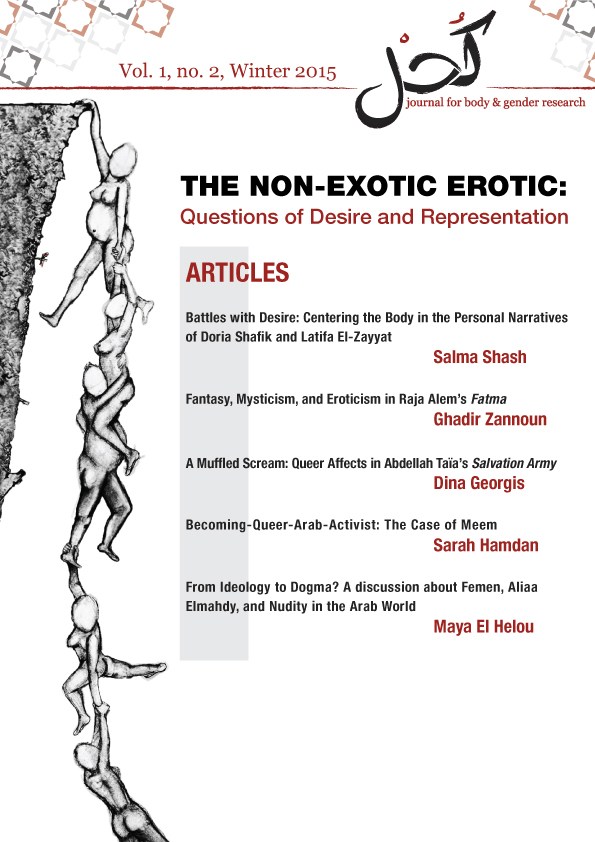
Kohl: The Non-Exotic Erotic – Questions of Desire and Representation

The winter edition of Kohl: A Journal for Body and Gender Research, Vol. 1, No.2 is available in English and Arabic.

Kohl-Issue-2-cover-en

THE NON-EXOTIC EROTIC
Questions of Desire and Representation

Editorial

The Erotic, the Exotic, and the Space(s) in Between: The Race for Feminist Waves
Ghiwa Sayegh
Kohl 1.2: pp. 1-5

Opinion Piece

Curse Words: The Language of (Hetero)Intimacy
Cynthia El Khoury
Kohl 1.2: pp. 6-10

Testimony

The Hystory of My Vagina: A Manifesto
Lady Gya
Kohl 1.2: pp. 11-16

Openings

Of Periods, Bodies, and Desire:
A Discussion on the Erotic Image in Artistic Representations
Rebecca Saab Saadeh
Kohl 1.2: pp. 17-25

Sex Tourism and the Military in Biomythographic Performances: An Interview with Jessika Khazrik
Ghiwa Sayegh
Kohl 1.2: pp. 26-30

Articles

Battles with Desire:
Centering the Body in the Personal Narratives of Doria Shafik and Latifa El-Zayyat
Salma Shash
Kohl 1.2: pp. 31-43

Fantasy, Mysticism, and Eroticism in Raja Alem’s Fatma
Ghadir K. Zannoun
Kohl 1.2: pp. 44-55

A Muffled Scream: Queer Affects in Abdellah Taïa’s Salvation Army
Dina Georgis
Kohl 1.2: pp. 56-65

Becoming-Queer-Arab-Activist: The Case of Meem
Sarah Hamdan
Kohl 1.2: pp. 66-82

From Ideology to Dogma?
A discussion about Femen, Aliaa Elmahdy, and Nudity in the Arab World
Maya El Helou
Kohl 1.2: pp. 83-92

Commentary

One Is Not Born, But Rather Becomes, Joumana
Sanaa Khoury
Kohl 1.2: pp. 93-97

Resource

Genre et éducation sexuelle dans le système éducatif marocain
Zouhair Gassim
Kohl 1.2: pp. 98-107

Reposted from: Kohl

Sisters in Islam denounces Malaysian MP’s suggestion that marriage would stop statutory rape

2 January 2016

Sisters in IslamPAS’s ulama council information chief has made a mockery of Islam with his suggestion that marriage would solve a high percentage of underage rape cases in the country, Sisters in Islam (SIS) said today.

The non-governmental organisation for Muslim women’s rights said Datuk Dr Mohd Khairuddin Aman Razali’s statement on Facebook recently was appalling and erroneous.
“Islam does not allow for underage marriages, especially if it is to the perpetrator himself, i.e the underage girl’s rapist.

“As a Member of Parliament, it is shocking that YB Khairuddin would undermine the severity and emotional trauma experienced by victims of underage rape cases,” SIS said, in reference to the Kuala Nerus MP’s Facebook post on Wednesday.

Khairuddin had also been reported in the media as saying marriage was the “most potent medicine in Islam to curb the social ill.”

“Society, specifically parents, must encourage and facilitate the marriage of their children.

“While the government must help provide incentives to lessen the burden of couples planning to get married,” he reportedly said.

The PAS lawmaker had been commenting on sexual crime statistics from Bukit Aman that showed 920 out of 1,794 cases reported this year involved statutory rape.

Khairuddin also claimed that 90% of the statutory rape cases were “suka sama suka” (consensual).

SIS considered this remark by Khairuddin to be irresponsible and misleading.

“Rape can never be consensual even if an underage girl does not explicitly say no, thus the term ‘statutory rape’.

“It is time we view rape as a crime that it actually is and a violation of human rights.

“Rape is a despicable act that is sinful in Islam and cannot be awarded with marriage.”

SIS added that Malaysia, as a signatory to the Convention of Elimination of all forms of Discrimination Against Women (CEDAW) and Child Rights Convention (CRC), had an obligation to ensure underage girls get access to higher education and achieve their potential, instead of allowing child marriages as a solution to statutory rape.

Reposted from: The Malaysian Insider

Other sources: Malaysia Kini, The Star Online